
In short
It's used in cakes, baby formula, emergency rations, and even morning coffee. Yet, few people really know how powdered milk is made. A white, unassuming product that actually conceals a precise and well-controlled industrial process.
This article reviews all the stages of milk transformation into powder, from the farm to the metal can, also explaining its composition, its concrete advantages and its many uses in cooking and industry.
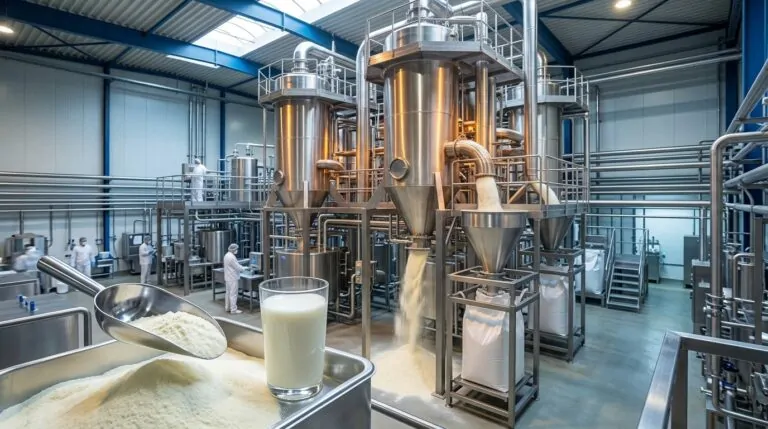
The process of manufacturing powdered milk

The process of manufacturing powdered milk is based on a simple logic: removing the water from fresh milk while preserving its nutrients, as this powdered milk supplier to individuals and professionals.
In practice, this involves three major successive stages, each with a well-defined role in transforming the liquid into a fine powder.
Milk standardization and pasteurization
Before any processing, the collected milk is analyzed and adjusted.
Milk standardization involves regulating its fat content to obtain a homogeneous product, regardless of the farm of origin, since this rate varies according to the type of powder sought: whole, semi-skimmed or skimmed.
Next comes pasteurization, where the milk is heated to a high temperature, between 72°C and 85°C for a few seconds, to eliminate pathogenic bacteria.
This step ensures the microbiological safety of the final product.
According to ANSES, pasteurization is the reference method for ensuring the safety of dairy products intended for human consumption.
Evaporation to concentrate liquid milk
Once pasteurized, the milk passes through vacuum evaporators, and the evaporation of the liquid milk takes place at a low temperature, around 50 to 70 °C, which allows a large part of the water to be eliminated without degrading the proteins or the heat-sensitive vitamins.
At the end of this stage, the milk has lost approximately 85% of its water, becoming a thick, almost syrupy concentrate. This concentrate is then ready for the final, most spectacular stage of the process.
Spray drying: the key step
Spray drying is the heart of the process, and the concentrated milk is sprayed into fine droplets in a drying tower through which a flow of hot air passes (between 150 °C and 200 °C).
In a few seconds, the residual water evaporates and the droplets solidify into tiny particles of powder.
The result is a fine, fluid and stable powder.
Food industry professionals point out that this technique preserves nutrients better than other drying methods, particularly due to the brief contact with heat.
🥛 Powdered milk reconstitution calculator
Easily find the right amounts of powdered milk and water according to your needs.
The principle of dehydration and preservation
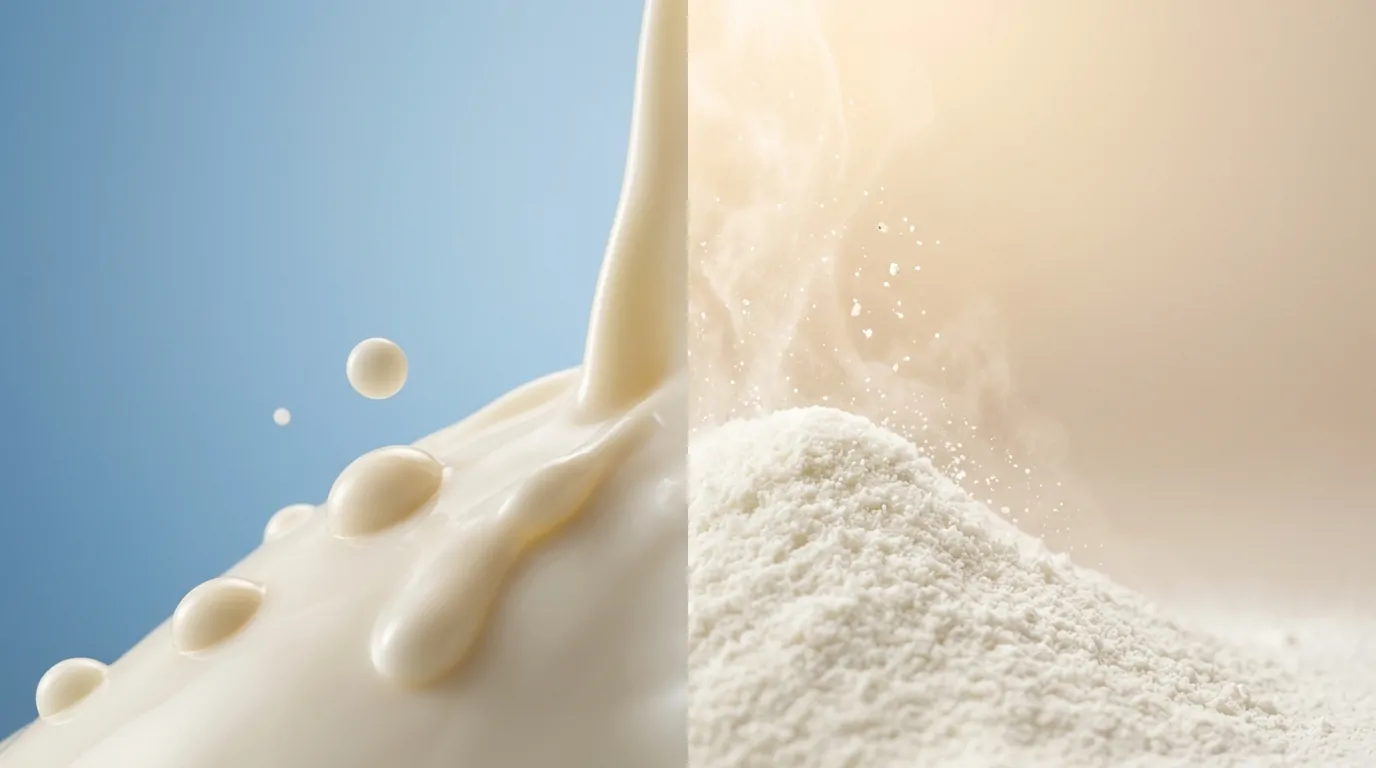
Understanding the dehydration of industrial milk helps to better understand why this product can last for months, or even years, without deteriorating.
It all rests on a simple chemical principle: without water, microorganisms cannot develop.
How does dehydration eliminate moisture?
Dehydration does more than simply "dry" the surface of the milk; it also extracts the free water contained within the cells and the milk solution itself. The spray-drying process reduces the moisture content of the final product to less than 5%, sometimes as low as 3%.
At this level of humidity, the enzymes responsible for food degradation can no longer function, because the bacteria, deprived of the water they need to multiply, remain inactive.
It is this drastic reduction in water activity that makes the product stable at room temperature.
Why does powdered milk keep for so long?
The preservation of powdered milk relies on two pillars: low water content and airtight packaging.
A box of whole milk powder, properly sealed, can be kept for up to 12 to 24 months according to manufacturers, and skimmed milk, which is lower in oxidizable fats, often lasts even longer.
A moisture content of less than 5% is the threshold which guarantees the microbiological stability of powdered milk under normal storage conditions.
However, the fats in whole milk can oxidize over time, which alters its taste.
This is why packaging is often under a protective atmosphere or vacuum, with a nitrogen sachet to limit contact with oxygen.
The ideal storage conditions to be observed
To fully benefit from the shelf life of powdered milk, a few common sense rules apply.
The product must be stored in a cool, dry place away from direct light, as heat and humidity are its two main enemies!
Once opened, the powdered milk must be carefully resealed and consumed within the manufacturer's specified timeframe, usually 3 to 4 weeks. Ambient humidity can alter its texture and promote mold growth.
The main conservation parameters are therefore:
- An ideal temperature: between 10°C and 25°C
- Relative humidity: less than 65%
- The container: airtight box or resealable bag
- Avoid proximity to strongly scented foods (as powdered milk absorbs odors)
Composition and nutritional value
Many people believe that turning milk into powder causes it to lose its organoleptic qualities, but this is a misconception that needs to be qualified.
The nutritional value of powdered milk is generally well preserved, although some adjustments exist depending on the process used.

The nutrients in powdered milk
Powdered milk contains the same nutrient families as fresh milk: proteins, carbohydrates (mainly lactose), lipids, calcium, phosphorus and vitamins.
Proteins, particularly casein and whey proteins, are maintained in their structure thanks to the speed of spray drying.
The calcium remains very well preserved, and this is one of the arguments often put forward by nutritionists to recommend this product in countries where access to fresh milk is difficult.
Experts point out that the bioavailability of minerals in powdered milk is comparable to that of liquid milk.
Powdered milk vs. liquid milk: a nutritional comparison
When reconstituted in equivalent quantities, the comparison between powdered milk and liquid milk gives fairly similar results.
The differences mainly concern heat-sensitive vitamins and polyunsaturated fatty acids, which are slightly reduced when heated.
| Nutrient (per 100 ml reconstituted) | Whole milk powder | Whole liquid milk |
|---|---|---|
| Proteins | 3.4 g | 3.2 g |
| Lipids | 3.7 g | 3.6 g |
| Carbohydrates | 4.8 g | 4.7 g |
| Calcium | 120 mg | 118 mg |
| Vitamin B12 | 0.4 µg | 0.4 µg |
These values show that milk reconstituted from powder is nutritionally very close to fresh milk for the majority of nutrients.
Vitamins and minerals are preserved after drying
Spray drying is fast! And this speed limits vitamin loss.
The B vitamins, riboflavin and vitamin B12 in particular, are rather well preserved, and calcium or phosphorus, which are not sensitive to heat, remain intact.
On the other hand, vitamin C, which is naturally very low in milk, may be slightly reduced.
As for vitamin D, which is fat-soluble, it is well preserved in whole milk powder.
Some manufacturers enrich their product with vitamins A and D to compensate for slight losses related to the process.
For people with lactose intolerance, there are lactose-free powdered milks available. The mineral composition remains the same as regular milk, with the same calcium content.
The different types of powdered milk

Not all powdered milks are the same!
The different types of powdered milk vary according to their fat content, their intended use and sometimes their enrichment with specific nutrients.
Whole milk, semi-skimmed milk and skimmed milk: what are the differences?
The main difference between these three varieties lies in their fat content, which is adjusted during the initial standardization.
- Whole milk powder : it contains at least 26% fat. It is richer in calories and fat-soluble vitamins (A, D, E, K). Its taste is creamier, making it popular in cooking and baking.
- Semi-skimmed milk powder : its fat content ranges from 1.5% to 25.5%. This is the most common compromise, used both at home and in industry.
- Skimmed milk powder : it contains less than 1.5% fat. It is lower in calories, proportionally higher in protein, and has a longer shelf life due to the absence of oxidizable fats. It is a product widely used in the food industry.
The choice between these three forms depends on the intended use and nutritional needs.
Comparative tests indicate that whole milk gives better results in pastry making, while skimmed milk is preferred in industrial preparations where fat content needs to be controlled.
Infant formula and its specific characteristics
milk powder is a category in its own right, subject to strict regulations.
This is not simply classic powdered milk packaged differently, and its composition is enriched and adapted to the nutritional needs of infants and young children.
Infant formulas contain essential fatty acids (DHA, ARA), prebiotics, probiotics, vitamins and minerals in adjusted proportions.
Their protein content is often reduced compared to standard cow's milk, because infants' kidneys are not yet able to process too high a protein load.
Several categories can be distinguished:
- Infant formula (stage 1) : from birth to 6 months
- Stage 2 milk : from 6 months to 12 months
- Growing-up milk : from 1 to 3 years old
These products are governed by specific European directives; however, the manufacture of infant milk follows the same major steps as conventional milk (pasteurization, evaporation, atomization), but with significantly more rigorous quality controls at each stage.
The tangible benefits of powdered milk

Beyond its extended shelf life, the advantages of powdered milk are numerous and tangible.
Practical, suitable for logistics, economical: this product meets a wide variety of needs, from everyday domestic use to large-scale emergency situations.
- Long shelf life without refrigeration
- Easy to transport and store
- Competitive price-quality ratio
- Reduces food waste
- Nutritional value close to that of fresh milk
- Versatile in both kitchen and industrial settings
- Taste slightly different from fresh milk according to some consumers
- Requires a reconstitution step
- Whole milk can oxidize over time
- Some cheap products lack transparency regarding the quality of the milk they use
Practicality, transportation, and waste reduction
One liter of liquid milk weighs approximately 1 kg and requires a suitable cold chain, while the same quantity reconstituted from powder weighs only about 130 g in its dry state.
This is a considerable logistical advantage for transport, storage or travel!
Powdered milk also reduces waste, because unlike fresh milk which spoils in a few days, powder is consumed as needed, without the constraint of a short date.
An opened box lasts for several weeks, which limits unused leftovers.
A major asset for global humanitarian aid
In crisis situations, powdered milk will play a role that few other foods can provide, since it is light, stable, nutritious and only requires water to be reconstituted.
Organizations such as UNICEF or the World Food Programme regularly distribute them in areas of conflict or natural disaster.
It represents an accessible source of protein and calcium in contexts where the cold chain does not exist.
For infants whose mothers cannot breastfeed, powdered infant formula is sometimes the only option available in these situations.
A price-quality ratio that is often competitive
With comparable nutritional value, powdered milk is often cheaper than fresh milk, especially when taking into account the shelf life and the absence of losses due to expiry.
Families who cook a lot often find that buying a large format of powder is more economical in the long run.
Catering professionals, pastry chefs, and ice cream makers also use it for this reason: because it is a bulk supply, stable over time, without the risk of shortages due to missed fresh milk deliveries.
Uses of powdered milk in cooking

The use of powdered milk in cooking is much more widespread than you might think!
Indeed, from artisanal bakeries to large industrial production units, this product is used in dozens of different recipes and processes.
Powdered milk used in pastry and baking
In pastry making, powdered milk provides structure and flavor without adding excessive moisture, such as in brioche dough or sponge cakes, where it strengthens the texture and improves browning during baking, thanks to the Maillard reaction between proteins and sugars.
In baking, it improves the texture of the crumb and prolongs the freshness of the bread
It is also used in the composition of many cooked dairy preparations, such as milk vermicelli (widely consumed in Portugal), where it will enhance the creamy aspect without weighing down the recipe.
His role in the agri-food industry
In the industry, powdered milk used as a food ingredient is everywhere!
It is used in the composition of milk chocolates, ice creams, sachet soups, dehydrated sauces, industrial bakery products and nutritional supplements.
Food technologists appreciate its stability and ease of dosing, because unlike liquid milk, it does not require special storage conditions before use and integrates directly into dry mixes.
It is also used to standardize the protein content of certain processed dairy products.
Professional ice cream makers, for example, incorporate it into their mixes to adjust the texture of their preparations.
Homemade recipes like vanilla rice pudding can also benefit from a pinch of powdered milk to achieve a creamier consistency.
And in more creative preparations, some do not hesitate to add it to a pistachio milk liqueur to bring roundness.
How can I easily recreate it at home?
Reconstituting milk from powder is very simple!
The general rule is to incorporate about 125g of powder into 1 liter of lukewarm water, then mix well until completely dissolved.
It is best to use water at 40-50 °C to facilitate dissolution, especially for whole milk whose fats dissolve less well in cold water.
Always pour the powder into the water, not the other way around. This prevents lumps and ensures even dissolution. A whisk or immersion blender will give a smoother result in seconds.
Reconstituted milk should be consumed within 24 hours and kept refrigerated, just like fresh milk, and it can be used in all recipes without any change in proportions.
Answers to your questions
How is powdered milk made, in simple terms?
Fresh milk undergoes four main stages: standardization (adjusting the fat content), pasteurization (heating to eliminate bacteria), evaporation (removing most of the water), and then spray drying (spraying into fine droplets in a stream of hot air). The result is a fine, stable powder containing less than 5% moisture.
Is powdered milk as nutritious as fresh milk?
Overall, yes. Protein, calcium, phosphorus, and most vitamins are well preserved after spray drying. Slight losses of heat-sensitive vitamins may occur, but they remain limited. At equivalent reconstituted quantities, the nutritional value of powdered milk is very close to that of liquid milk.
Can powdered milk be used instead of fresh milk in all recipes?
Yes, in the vast majority of recipes, reconstituted milk from powder can replace fresh milk in equal volumes. It is suitable for baking, savory dishes, sauces, and creams. Some consumers notice a slight difference in taste when cold, but this becomes imperceptible when cooked.
How long does powdered milk last once opened?
Once opened, powdered milk should generally be consumed within 3 to 4 weeks, according to the manufacturer's instructions. It should be stored in an airtight container, away from moisture and heat. Whole milk powder is more susceptible to oxidation than skimmed milk, so it should be used first after opening.
Why is infant formula different from regular formula?
Infant formula is a specially formulated product adapted to the nutritional needs of babies. Its protein content is reduced, and it is enriched with essential fatty acids (DHA), vitamins, and minerals according to strict regulatory standards. It cannot be replaced by regular powdered milk for feeding an infant, as its composition is not suited to their physiology.
